It feels like Pilates studios are popping up on every corner lately, the 2020s version of the frozen yogurt craze. But as the “low-impact” movement takes over our feeds, a serious question remains for the fitness-conscious: Can those hundreds and leg circles truly replace a session at the weight rack?
In This Blog
Is pilates considered strength training?
With research consistently showing that traditional strength training can lower the risk of early death by up to 17%, the stakes for your workout routine are high. To find out if Pilates is a sufficient “one-and-done” for strength, we sat down with top industry pros to separate the trend from the science.
We asked our experts to share their insights on what is the actual truth… Is pilates cardio or strength training? Let’s briefly explain to you guys what our experts think on that!
Let’s start with what is Pilates?
The truth is; It’s More Than Just a Trend
While it feels like the “newby shy kid” in the practical fitness world, Pilates actually dates back to the 1920s. Created by Joseph Pilates, a former circus performer and medical enthusiast, it was originally designed to rehab injured soldiers and dancers. So, it’s definitely not a new thing!
You wanna know the focus of pilates? Control, alignment, and “the powerhouse” (your core).
Our Experts Comments
Pilates actually helps you improve your balance, flexibility, and posture while also making your muscles bulky and strong,” says our expert.
Our another expert said;
If you are worrying about the effect of pilates on your movement and activities, then don’t. It’s really good on the joints, but when done with real focus and goal, it can be extremely challenging.
Well, if the answer to the main question “Is Pilates Strength Training?” is Yes, then let’s discuss a few types of pilates to help you decide what you need to start your fitness journey with.
Mat vs. Reformer: Which Builds More Muscle?
Mat Pilates: Use your own body weight. It’s accessible and can be done anywhere, but has a “ceiling” for resistance.
Reformer Pilates: Uses a sliding carriage and springs. Because you can add spring tension, it’s the clear winner for those looking to build significant lean muscle.
Is Pilates Strength Training? The Verdict
Can It Replace Weightlifting? Our experts agree: For the average person, Pilates is absolutely enough to be considered “sufficient” strength training. However, there is a caveat. “If your goal is to build maximal muscle mass, high bone density, or the kind of strength needed to lift heavy furniture, I’d recommend adding traditional weight training,” says our top expert.
Why Pilates Offers Strengths That Weights Don’t
If you’re on the fence about switching from the gym to the studio, consider these unique benefits that traditional lifting often misses:
Mind-Body Alignment: Pilates teaches you the relationship between your ribs, pelvis, and spine. This “body awareness” makes you safer and more efficient in every other sport you play.
The Power of Breath: Pilates uses a specific ribcage-expansion breathing technique. Studies show this stabilizes the trunk and minimizes stress on the spine, something many heavy lifters forget to do.
Eccentric Control: This is the “secret sauce.” Pilates focuses on lengthening muscles under tension (the “down” phase of a movement), which builds incredibly resilient tendons and ligaments.
Lean Endurance: Instead of low reps with heavy weights, Pilates uses long working sets. The result? A long, lean aesthetic and high muscular endurance.
After learning about all these benefits, I am sure you would never want to quit. Right? So, let’s explore what could be the potential weaknesses of Pilates.
Filling the Gaps: What’s Missing?
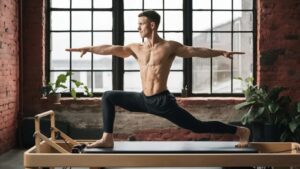
While Pilates is a powerhouse for the core, it isn’t a total-body miracle. So, you must be aware of the drawbacks. Our expert points out two main “holes” in a Pilates-only routine:
Cardiovascular Health: Pilates rarely gets your heart rate into a true cardio zone.
Progressive Overload: It is harder to “quantify” gains in Pilates compared to simply adding five pounds to a barbell.
Still confused on “Is Pilates Considered Strength Training?”
The Solution: Use Pilates as a “complementary” workout. It builds the stability and mobility that allow you to run, cycle, and lift weights for longer, with a much lower risk of injury.
4 Ways to Maximize Your Pilates Gains
If you want to skip the gym and stay in the studio, use these pro tips to ensure you’re still getting a “strength” workout. With these 4 amazing tips shared by our experts, you can get the most from pilates.
Slow It Down: The magic happens in the slow, controlled return. Don’t let the springs snap back; resist them.
Increase Tension: Don’t get comfortable. If a move feels easy, ask your instructor for a more challenging spring setting or a harder variation.
Focus on “Time Under Tension”: Instead of counting reps, aim to keep the muscle working for 60 to 90 seconds straight.
Engage the Powerhouse: Don’t just move your limbs. Ensure your core is “zipped up” before the move even starts.
So, Is Pilates Strength Training?
The bottom line is if you’d rather hit the reformer than the squat rack, go for it. As long as you’re challenging yourself and staying consistent, your muscles (and your posture) will thank you.
When you find yourself asking “Is pilates cardio or strength training”, remember that its strength lies in the “middle way”, it offers the resistance your muscles need without the high-impact stress that often leads to burnout or injury. By focusing on form, tension, and breath, you can build a body that is as strong as it is supple.